


Views: 0 Author: Site Editor Publish Time: 2026-09-04 Origin: Site


Contamination during anode sintering is never a minor operational hiccup. It operates as a primary driver of lithium-ion battery failure, costly safety recalls, and reduced cycle life. Processing artificial graphite requires absolute precision. We cannot ignore the container holding the powder. The sintering container itself often acts as a critical contamination vector. Inferior containers degrade rapidly under extreme heat. They introduce trace metals and volatile carbon ash directly into the active material. This ruins the electrochemical properties of the powder.
This article provides process engineers and procurement leads a verifiable evaluation framework. You will learn how to assess and select high-performance holding containers. We will explore ways to protect battery-grade purity while maintaining steady production lines. By focusing on material integrity, you can optimize your high-temperature processes. You will discover practical methods to mitigate trace metal migration and maximize thermal cycle longevity.
Contamination in anode sintering—specifically trace metal migration and carbon spalling—directly correlates with catastrophic micro-shorts in EV batteries.
Upgrading to a high-purity graphite sagger reduces ash content and foreign particle introduction compared to standard industrial crucibles.
Evaluation must extend beyond baseline purity to include thermal shock resistance, graphitization degree, and dimensional stability.
Trace metals spell disaster for lithium-ion cells. Elements like iron, copper, and zinc migrate from inferior containers during high-temperature processing. These metals embed themselves into the artificial graphite powder. Inside the assembled cell, they dissolve into the electrolyte. They eventually deposit onto the anode surface. This unwanted deposition causes localized dendritic growth. Dendrites are sharp, metallic structures. They pierce the thin polymer separator. Once they bridge the anode and cathode, they trigger catastrophic thermal runaway. EV manufacturers simply cannot tolerate this safety risk.
Yield loss carries massive financial penalties. EV manufacturers enforce incredibly strict purity thresholds. They test incoming anode powders rigorously. If your batch exceeds allowable impurity limits, the buyer will reject it. Scrapping tonnes of processed artificial graphite destroys profit margins immediately. Contaminated batches require expensive reprocessing or outright disposal. We must view the holding container as an active participant in yield preservation. If the container flakes or off-gases, it ruins the entire load.
Extreme heat distorts weak containers over time. Physical deformation leads to uneven heat distribution across the powder bed. This uneven heating alters the electrochemical consistency of the anode material. Process engineers call this physical warping the overhang effect. When containers warp, the powder near the edges sinters differently than the powder in the center. We see this inconsistency manifested in poor charge capacities. It directly reduces the final battery lifespan. Dimensional stability under heat is non-negotiable.
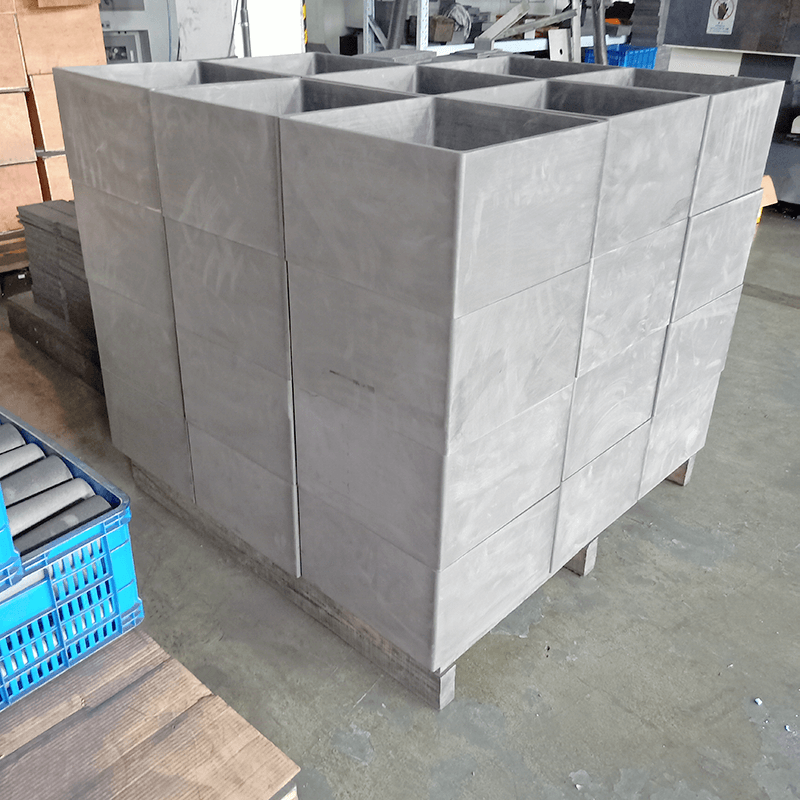
Traditional ceramic or low-grade carbon containers fail under extreme parameters. Artificial graphite anode processing demands temperatures exceeding 2500°C. Ceramics crack severely under these intense thermal gradients. They cannot survive rapid heating and cooling cycles. Low-grade carbon containers present a different danger. They release massive amounts of volatile ash and sulfur. This off-gassing introduces massive structural defects into the anode powder. You cannot use standard industrial crucibles for EV-grade battery materials.
Safety dictates strict material selection. You must utilize specialized containers to ensure complete chemical inertness. Manufacturers use deep purification processes to achieve this standard. They often employ halogen gases at extreme temperatures. This process strips out metallic impurities from the raw carbon. Standard applications accept ash contents below 50 ppm. However, premium EV grades often require ash levels below 20 ppm. Achieving this purity baseline eliminates the primary source of foreign particle introduction.
Fully graphitized containers provide unmatched chemical inertness. The high degree of crystallization prevents the container from reacting with the enclosed powder. Graphitization locks the internal molecular structure. It aligns the carbon atoms into highly ordered planes. This alignment increases thermal conductivity and prevents structural degradation. It ensures uniform heat transfer across the entire anode batch. It prevents carbon dust from mixing into the final product.
You must evaluate a graphite sagger for anode materials using hard data. Always validate supplier certificates of analysis (COA). Look closely at the allowable parts-per-million (ppm) levels. Focus specifically on transition metals. Iron, zinc, and copper act as the worst offenders in battery systems. A reliable supplier provides third-party testing data. They should guarantee maximum limits for each critical element. Never accept vague purity claims without elemental breakdowns.
Bulk density and apparent porosity determine long-term survival. High bulk density blocks volatile gas infiltration. Low apparent porosity keeps the internal walls sealed. If corrosive gases penetrate the container walls, they weaken the structure from the inside. This penetration leads to rapid oxidation and physical crumbling. Dense materials prevent this hidden degradation. They maintain structural integrity over dozens of high-heat cycles.
Evaluate the coefficient of thermal expansion (CTE) carefully. Saggers undergo intense, rapid heating and cooling cycles. A lower CTE ensures they survive these extreme shifts. It prevents micro-cracking along the base and corners. When materials expand and contract unevenly, they fracture. Low CTE materials absorb these stresses naturally. They maintain their exact dimensional footprint inside the furnace.
Surface integrity is a critical evaluation metric. A rough, porous surface leads to carbon dust flaking off. Engineers call this flaking "spalling." Spalling directly contaminates the anode powder batch. It introduces irregular carbon chunks into the finely milled powder. You need a smooth, highly finished interior cavity. A polished surface minimizes friction during powder loading and unloading. It prevents edge chipping and surface erosion.
Property | Minimum Requirement | Impact on Sintering Process |
|---|---|---|
Ash Content | < 50 ppm (EV Grade: < 20 ppm) | Prevents trace metal migration and micro-shorts. |
Bulk Density | > 1.85 g/cm³ | Blocks corrosive gas infiltration and extends lifespan. |
Apparent Porosity | < 10% | Reduces structural degradation and surface flaking. |
Thermal Expansion (CTE) | < 4.0 × 10⁻⁶ /°C | Prevents micro-cracking during rapid cooling cycles. |
All carbon materials degrade when exposed to oxygen at high temperatures. You must acknowledge this chemical reality. You need strict furnace atmosphere control to maximize operational life. Use inert gas blanketing continuously. Nitrogen or argon gas works best for this application. Proper gas flow prevents oxygen from reaching the heated containers. Even minor oxygen leaks will cause the material to burn away. Monitor furnace seals relentlessly.
High-purity containers often exhibit mechanical fragility. They require careful, deliberate handling. Factory floors present numerous physical hazards. Forklifts and manual loading processes cause accidental impacts. Implement automated handling systems where possible. Robotic arms provide smooth, predictable movements. Update your standard operating procedures (SOPs) immediately. Train operators to prevent edge chipping. Chipped edges create immediate physical contamination risks.
Move past optimistic manufacturer claims. Establish a baseline for cycle life inside your specific furnace. Every production environment differs significantly. Track physical wear systematically after every run. Replace the container before degradation impacts your anode yield.
Follow these steps to assess lifespan accurately:
Weigh the new container upon arrival to establish a baseline mass.
Run three standard thermal cycles under strict inert gas blanketing.
Inspect all corners and edges visually for microscopic fractures.
Weigh the container again to calculate exact oxidation loss.
Measure ash generation inside the cavity using a clean white cloth.
Supplier quality management systems (QMS) matter immensely. Finding a good sample is easy. Securing consistent volume is difficult. A single inconsistent batch of containers will ruin tonnes of valuable anode material. You must audit their production consistency regularly. Request historical control charts. Verify their raw material supply chain. They must source premium needle coke consistently to maintain high-density outputs.
Standard sizes rarely optimize furnace loads. Off-the-shelf dimensions leave empty gaps inside the heating chamber. Work closely with suppliers to customize geometries. Tailored dimensions maximize capacity per run. They also improve heat distribution across the stack. A custom fit reduces thermal shadowing. It ensures every kilogram of powder reaches the target sintering temperature simultaneously.
You must source a graphite sagger for lithium-ion battery materials that aligns with global standards. International EV battery compliance rules grow stricter every year. Sustainability targets now dictate material sourcing guidelines. Traceability from raw coke to the finished product is mandatory. Ensure your vendor operates under certified environmental management systems. Ethical sourcing prevents future supply chain disruptions.
Scale your procurement intelligently. Never switch suppliers overnight without rigorous testing. Follow a disciplined framework to minimize operational risks.
Request detailed COAs and small material samples from three shortlisted vendors.
Conduct small-batch thermal tests in your internal R&D furnace.
Analyze the sintered anode powder for sudden impurity spikes.
Run a localized production trial focusing on physical handling limits.
Scale to full production only after validating fifty successful thermal cycles.
Managing contamination risk requires a comprehensive approach. You must evaluate the holding container as a critical variable in battery performance. A holistic view prioritizes baseline purity, physical density, and thermal stability. Ignoring these metrics guarantees yield loss and compromises EV safety. Superior graphitization prevents chemical reactions and locks out trace metals. By implementing strict handling procedures, you preserve structural integrity.
Take these actionable steps to protect your production line:
Audit your current sintering containers for trace metal leakage and surface spalling.
Initiate controlled pilot tests with two or three verified high-purity vendors.
Prioritize precise ash content data and cycle longevity metrics above standard acquisition metrics.
Implement strict inert gas protocols and automated handling to extend operational lifespans.
A: Standard industrial applications require an ash content below 50 ppm. However, premium EV battery grades often demand less than 20 ppm. Trace metals like iron and zinc cause devastating micro-shorts inside cells. Keeping ash levels strictly below these thresholds prevents metallic impurities from migrating directly into the active anode powder.
A: A premium container typically withstands between 30 and 60 thermal cycles. However, this lifespan remains highly environment-dependent. Operating temperatures exceeding 2800°C will stress the material. Suboptimal inert gas blanketing accelerates oxidation rapidly. Perfecting your nitrogen or argon flow extends cycle longevity significantly.
A: Yes, it has an indirect but significant impact. High porosity allows volatile gases to infiltrate the container walls. This infiltration degrades structural integrity rapidly. It introduces hidden impurities into the powder batch. These foreign particles ultimately degrade the final battery's specific capacity and overall electrochemical performance.
A: You should conduct a rigorous thermal shock test during the initial pilot phase. Subject the empty container to your precise heating and cooling profile. Afterward, perform a physical surface integrity check. Wipe the interior cavity with a clean white cloth. This simple test reveals hidden carbon dust flaking instantly.

 +86-795-4605783
  sales@nhdcarbon.com
  No. 966 of Tiangong South Avenue, High-tech Industrial Park, Fengxin County, Yichun City, Jiangxi Province, China.


