


Views: 0 Author: Site Editor Publish Time: 2026-08-15 Origin: Site


The physical dimensions of graphite saggers directly dictate operational bottlenecks during anode material graphitization. A minor miscalculation in wall thickness immediately impacts energy consumption, batch yield, and thermal consistency. In the rapidly evolving new energy sector, specialized anode formulations are taking over the market. Artificial graphite and silicon-carbon blends require extremely precise thermal management. They need this strict control to achieve target electrochemical properties reliably. Standard, off-the-shelf crucibles often fail to meet these stringent processing demands.
This article provides plant engineers and procurement teams with an evidence-based framework for specifying sagger dimensions. We will guide you through balancing physical durability, maximum loading capacity, and vital energy efficiency. You will learn how to match internal volume to heating uniformities accurately. We also explain how to gauge thermal expansion risks and mechanical load limits effectively. By rethinking these crucial dimensions, production facilities can significantly improve their overall furnace output.
Sagger dimensions dictate the thermal mass penalty; optimizing wall thickness can reduce energy consumption during high-temperature calcination.
Increasing loading volume without adjusting internal geometries risks uneven graphitization and lower tier-1 anode yield.
Standard saggers often fail to align with proprietary furnace layouts, making a custom graphite sagger the most cost-effective long-term solution for high-volume producers.
Evaluating a sagger design requires balancing powder bulk density, thermal expansion rates, and the mechanical load limits of the stacking configuration.
Poorly sized saggers carry massive hidden costs for any manufacturing facility. We often see engineers overlook dimensional optimization in favor of immediate procurement speed. However, wasted furnace space limits your daily production volume drastically. If a crucible fits poorly inside a heating zone, you waste immense amounts of electrical energy heating empty space. Premature cracking is another major financial drain. Suboptimal dimensions create severe stress concentrators during rapid heating cycles. High ash contamination from degrading saggers ruins expensive anode batches entirely.
You must establish clear success criteria for a proper specification. A highly successful design achieves three primary outcomes consistently.
Maximized active material per batch: The design utilizes every available cubic millimeter of the heating zone efficiently.
Minimized thermal gradient: Heat penetrates the powder bed uniformly, preventing inconsistent graphitization degrees.
Predictable crucible lifespan: Wall thicknesses handle thermal shock reliably across dozens of high-temperature cycles.
To evaluate these factors, we introduce the "payload-to-tare weight ratio" as a critical key performance indicator. This metric measures the weight of the active anode powder compared to the weight of the graphite box itself. A higher ratio indicates superior furnace efficiency. It means you spend electrical energy heating the product, not the container. Modern graphitization lines must track this ratio relentlessly.
Start by weighing your current empty saggers accurately. Calculate the maximum tapped density of your powder load. Divide the powder weight by the empty sagger weight. If your ratio falls below industry averages, you likely have oversized walls or inefficient internal geometries. We recommend auditing this metric quarterly.
Matching a sagger to a specific furnace requires precise calculations. You determine the maximum external dimensions based on the usable uniform heating zone. You must also respect the strict limits of loading and unloading automation. Oversized boxes jam robotic grippers easily. They also disrupt conveyor belt alignments. Plant engineers should subtract a minimum clearance margin from the furnace cavity dimensions to ensure safe handling.
Internal volume constraints dictate your actual throughput. However, an inverse relationship exists between absolute capacity and core heating rates. If you push the internal volume too high by expanding the width, you compromise the heating speed. Heat takes significantly longer to reach the geometric center of a massive powder bed.
These thermal gradients pose a severe risk to product quality. Oversized saggers cause hidden "cold spots" in the center of the anode material. While the outer edges reach the target graphitization temperature of 2800°C, the center might lag hundreds of degrees behind. This delay leads to highly inconsistent graphitization. You ultimately harvest lower-tier anode material that fails strict battery manufacturer specifications.
Many procurement teams request the largest possible internal volume to boost batch size. They ignore the thermal conductivity limits of the anode powder itself. Uncalcined precursor acts as a thermal insulator initially. A massive box ensures the center remains cold for too long. Always prioritize thermal uniformity over raw absolute volume.
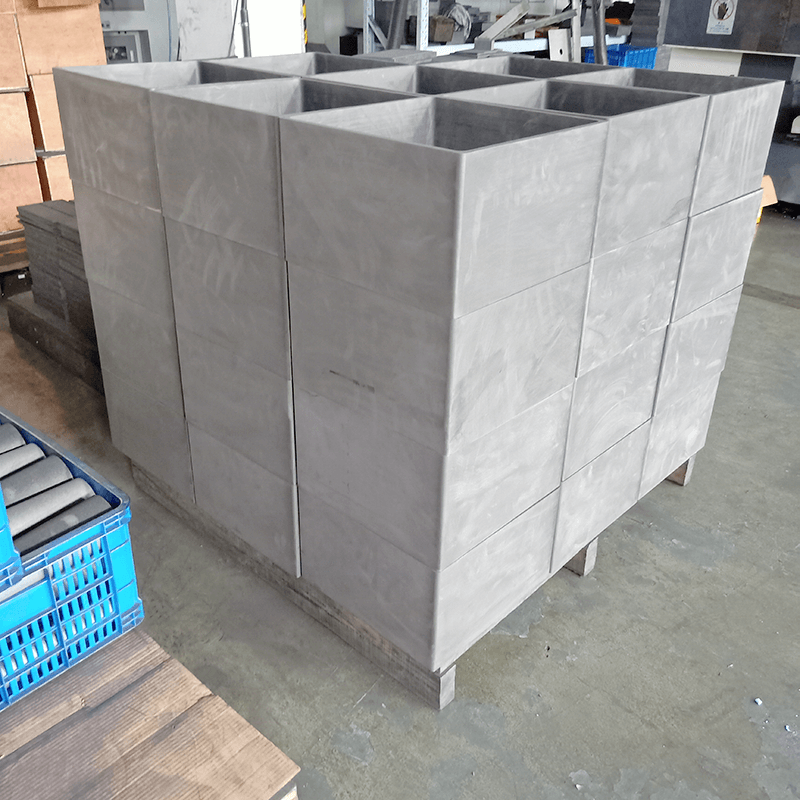
The thickness of a sagger wall represents the ultimate engineering compromise. You constantly balance operational durability against ongoing energy consumption. We classify these design paths into the thin-wall approach and the thick-wall reality.
The thin-wall approach focuses heavily on thermal efficiency. Thinner walls allow for much faster thermal transfer from the heating elements into the powder bed. This drastically lowers energy waste during the long heating cycles. However, this approach carries a higher risk of mechanical failure. Automated handling systems exert clamping forces that can crack thin walls. The thermal shock lifespan also drops quickly under rapid cooling phases.
The thick-wall reality prioritizes survival inside harsh industrial environments. Thick walls provide superior structural integrity against physical impacts. You get longer replacement cycles and more production runs per sagger. Unfortunately, the high thermal mass penalty is severe. Thick walls act as heavy insulators. They force operators to maintain longer furnace holding times to ensure the core reaches target temperatures.
Material density plays a pivotal role in this trade-off. Specifying high-bulk-density graphite fundamentally changes the calculation. When you use graphite with a bulk density exceeding 1.85 g/cm³, you gain massive mechanical strength. This superior strength allows you to design thinner walls without sacrificing structural integrity.
Strategy | Thermal Transfer Rate | Energy Consumption | Mechanical Durability | Best Application Use Case |
|---|---|---|---|---|
Thin-Wall Design | Very High | Low (Highly Efficient) | Lower (Prone to handling cracks) | Stationary furnaces, gentle manual handling |
Thick-Wall Design | Low (Insulating effect) | High (Thermal mass penalty) | Very High | Acheson furnaces, heavy automation lines |
High-Density Hybrid | High | Moderate | High | Continuous roller hearth furnaces |
Optimizing loading capacity relies heavily on understanding powder mechanics. You must factor in both the bulk density and the tap density of uncalcined anode precursors. A dense powder packs tighter and transfers heat differently than a fluffy precursor. Tap density dictates exactly how many kilograms of material you can fit into a specific internal geometry. We urge engineers to measure these powder metrics before finalizing any container dimensions.
Thermal expansion allowances are critical for safety and yield. You must design internal dimensions to accommodate the volumetric expansion of specific anode blends. During extreme heat treatment, internal structures reorganize into crystalline graphite. This phase change often causes the powder bed to expand outward. If the container lacks sufficient headspace or expansion width, the expanding powder will exert immense outward pressure. This pressure routinely fractures standard crucibles from the inside out.
Stacking and load bearing demand rigorous mathematical calculations. High-volume production relies on stacking saggers vertically inside Acheson or continuous furnaces. The bottom sagger bears the combined weight of the entire loaded stack. The bottom-wall thickness must scale perfectly according to this total weight. By adjusting a proper graphite sagger design for anode production, you ensure the base crucible survives the immense compressive forces. A failing bottom crucible can collapse an entire furnace column, destroying days of production.
Never assume standard wall uniformities work for stacked configurations. We recommend a variable thickness design. The base plate should always be significantly thicker than the side walls. Furthermore, inspect stacking joints for carbon dust buildup. Dust acts as a wedge, creating uneven stress distribution under heavy loads.
Knowing when to abandon off-the-shelf crucibles is a crucial procurement skill. Standard saggers work fine for basic applications. However, certain trigger points require immediate custom intervention. Transitioning to continuous roller hearth furnaces demands highly specific external profiles to ride the rollers smoothly. Introducing advanced silicon-based anodes also triggers this need. Silicon requires unique gas venting structures that standard boxes simply do not possess.
Geometry innovations drive the value of customization. We often explore custom features like contoured internal radiuses. Sharp internal 90-degree corners trap ungraphitized powder during automated dumping processes. A curved radius prevents powder packing in corners entirely. Interlocking stacking grooves represent another vital innovation. These machined grooves lock stacked boxes together securely, ensuring stability during mechanical vibration or conveyor movement.
The prototyping phase eliminates mass production risks. Always mandate the process of ordering a small-batch custom graphite sagger run. You must validate the thermal profiles inside your actual furnace environment. This trial run lets you physically measure the core powder temperatures. You can then tweak wall thicknesses or corner radiuses before scaling to a massive multi-thousand unit order.
Request at least three variations of wall thicknesses during your prototype run. Load them with identical powder weights and place them in the same furnace zone. Cut the resulting anode blocks open to inspect graphitization uniformity visually and chemically. This small upfront investment saves massive downstream failures.
You cannot execute a precise dimensional design without a highly capable manufacturing partner. Machining tolerances act as the first major filter for suppliers. Strict CNC dimensional tolerances are absolutely non-negotiable for automated loading lines. A tolerance deviation of just one millimeter can cause a robotic arm to drop a loaded box. Demand suppliers who guarantee tolerances within +/- 0.5mm across all critical dimensions.
Material purity directly impacts your final battery cell performance. Verifying the supplier's purification processes is mandatory. Saggers operate at temperatures where impurities easily vaporize and contaminate the powder bed. Ensure the supplier utilizes high-temperature halogen purification. The sagger must not leach trace metals like iron, vanadium, or sulfur into the anode material. We recommend demanding laboratory test reports showing total ash content below 50 parts per million.
Implementation risks often stem from poor supply chain management. Lead time volatility can halt your production entirely. Evaluate the importance of a supplier who controls their own raw graphite block supply chain. Suppliers who buy blocks from third-party markets suffer from extreme price and availability fluctuations. Integrated suppliers offer stable, long-term dimension consistency and predictable delivery schedules.
Sagger dimensions remain an intricate engineering compromise between throughput, lifespan, and thermal efficiency. Minor adjustments in wall thickness or internal volume yield massive shifts in energy consumption and graphitization consistency. By balancing these structural traits against the specific thermal mechanics of your anode powder, you achieve a highly efficient production line.
We strongly encourage you to audit your current payload-to-tare ratio immediately. Identify if heavy, oversized crucibles are inflating your electrical costs. Finally, contact specialized engineering teams with your exact proprietary furnace dimensions. A professional custom design review is the most reliable first step toward maximizing your battery material output.
A: Standard lifespan highly depends on wall thickness and operating temperatures. High-density, thick-walled designs can survive 30 to 50 heating cycles in Acheson furnaces. Thinner walls subjected to rapid thermal shocks may degrade after 15 to 20 cycles. Continuous operation at 2800°C accelerates oxidation and structural wear.
A: Thicker walls retain massive amounts of thermal energy. This thermal retention slows down the cooling phase dramatically. It creates throughput delays because the material must safely drop below oxidation thresholds before atmospheric exposure. Thinner walls dissipate heat much faster, accelerating overall batch turnaround times.
A: Yes. Reputable suppliers strongly encourage prototyping. You can order a small batch of 5 to 10 units with varied geometries. These trial runs allow you to validate thermal uniformity and automated handling compatibility before committing to a minimum order quantity of hundreds of units.
A: In a vacuum or highly controlled inert argon atmosphere, high-density graphite remains stable up to 3000°C. However, in the presence of even trace oxygen, severe oxidation and structural degradation begin at approximately 400°C to 500°C. Maintaining strict atmospheric control is vital for high-temperature survival.

 +86-795-4605783
  sales@nhdcarbon.com
  No. 966 of Tiangong South Avenue, High-tech Industrial Park, Fengxin County, Yichun City, Jiangxi Province, China.


