


Views: 0 Author: Site Editor Publish Time: 2026-08-03 Origin: Site


Scaling battery production faces a massive bottleneck today. You must maintain material purity and structural integrity during high-temperature thermal processing. Using the wrong containment vessel brings severe consequences. It leads to cross-contamination, poor thermal efficiency, and frequent vessel failure. These issues directly impact yield and cell performance in modern manufacturing facilities.
Containment vessels often look similar on the factory floor. However, the chemical and thermal realities of anode graphitization versus cathode calcination differ vastly. You need fundamentally different engineering approaches to handle them successfully. A vessel designed for inert, ultra-high-temperature environments will quickly degrade if exposed to oxygen-rich calcination. Understanding these core process differences ensures you select the correct containment strategy for your specific production line.
Anode requirements focus on extreme heat: A high-quality graphite sagger for anode materials must withstand temperatures exceeding 2800°C while maintaining dimensional stability in inert atmospheres.
Cathode environments are chemically hostile to carbon: Cathode materials (like LFP or NCM) require oxidizing environments that would rapidly degrade unprotected graphite, necessitating ceramic (mullite/cordierite) or specialized coated saggers.
Modern thermal processing furnaces rely heavily on durable containment vessels. Saggers act as primary shields for active battery materials. They isolate sensitive powders from volatile furnace atmospheres. Simultaneously, they ensure uniform heat transfer across the entire material bed. We rely on them to carry battery precursors through intense, days-long thermal cycles without compromising the final product.
You will encounter a crucial divide in production requirements across the battery industry. Anode baking requires inert environments and ultra-high temperatures. Manufacturers push furnaces beyond 2800°C to achieve full material graphitization. In contrast, cathode synthesis demands oxygen-rich environments. The processing temperatures sit much lower, usually between 700°C and 900°C, but the atmosphere remains highly corrosive to carbon-based vessels.
A specialized graphite sagger for lithium-ion battery materials acts as a baseline requirement for high-yield facilities. However, its specific formulation must match the active material being processed. You cannot swap vessels between these two vastly different environments without risking catastrophic failure.
Process Differences Chart: Anode vs. Cathode Processing
Process Variable | Anode Graphitization | Cathode Calcination |
|---|---|---|
Temperature Range | 2500°C - 3000°C+ | 700°C - 1000°C |
Furnace Atmosphere | Inert (Nitrogen/Argon) | Oxidizing (Oxygen/Air) |
Primary Chemical Risk | Impurity migration into powder | Lithium corrosion & carbon oxidation |
Ideal Sagger Material | High-purity isotropic graphite | Alumina, Mullite, or Coated Graphite |
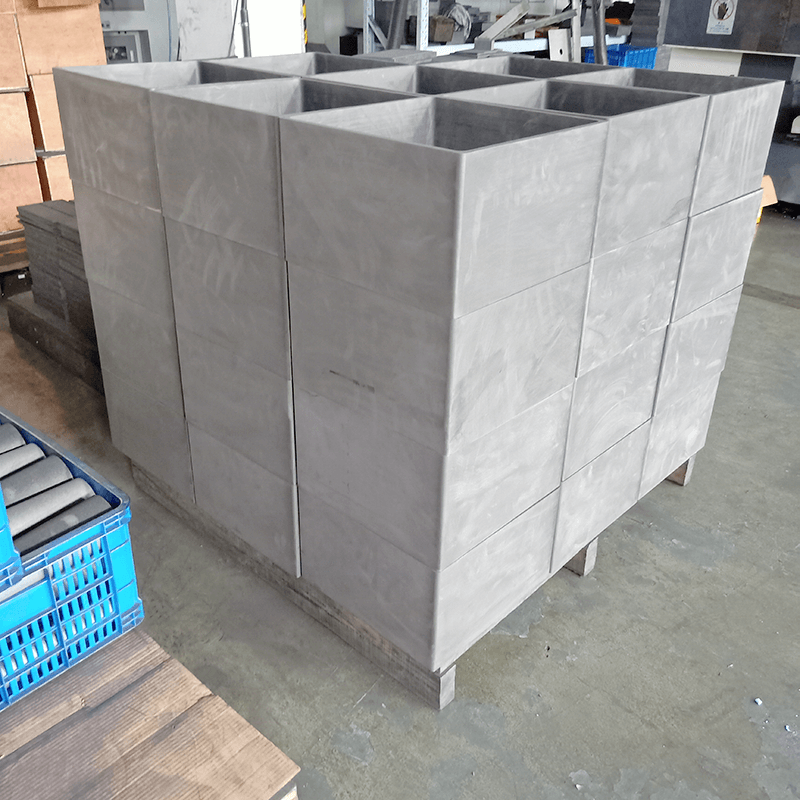
You must evaluate a vessel's ability to endure rapid heating and cooling cycles. High-performance containers handle these drastic temperature shifts without micro-cracking. Thermal expansion coefficients play a massive role here. Materials displaying low thermal expansion handle sudden temperature drops much better than dense, rigid alternatives.
Implementation realities show a harsh truth. Inadequate thermal shock resistance serves as the leading cause of premature failure in continuous graphitization furnaces. Micro-cracks start invisible to the naked eye. Over successive heating cycles, they propagate rapidly. Eventually, the structural integrity fails completely, spilling expensive precursor materials inside the furnace.
Best Practice: Always request thermal expansion coefficient (CTE) data across the specific temperature bands your furnace uses. Do not rely on ambient temperature CTE metrics.
Impurity migration poses a severe threat to battery performance. We must assess the risk of contaminants leaching from the vessel walls into the anode powder. Trace metals like iron, vanadium, and copper cause massive issues. They create micro-shorts inside the finished battery cell, increasing self-discharge rates and posing safety hazards.
You must demand strict verification of ultra-low ash content. For high-end electric vehicle (EV) applications, industry standards dictate ash levels below 50 ppm. Some premium applications push this requirement even lower, down to 20 ppm. Advanced purification processes during manufacturing vaporize these impurities before the vessel ever reaches your facility.
Vessel density directly influences operational longevity. Low porosity prevents the absorption of process byproducts. During high-temperature baking, precursor materials release volatile gases. If the vessel features high porosity, these gases penetrate the internal structure. Upon cooling, they solidify and cause internal stress.
Engineers optimize structural density to block this vapor penetration. This careful balancing act extends the operational life of a graphite sagger for anode materials significantly. However, pushing density too high can negatively impact thermal shock resistance. Manufacturers must strike an exact balance tailored to your specific heating curves.
Cathode synthesis operates under entirely different chemical realities. Cathode calcination fundamentally requires oxygen to form the correct crystalline structures in LFP or NCM materials. You cannot use inert atmospheres here. This creates an immediate problem for traditional carbon-based vessels.
Raw carbon oxidizes rapidly at these temperatures in oxygen-rich environments. Simply put, unprotected vessels will literally burn away inside the furnace. They lose mass, weaken structurally, and introduce carbon contamination directly into the sensitive cathode powder. This ruins the batch and damages furnace internal components.
Cathode precursors release volatile lithium compounds during the heating phase. Lithium vapor is exceptionally reactive. It aggressively attacks unprotected surfaces, penetrating the microscopic pores of standard vessels. This chemical attack fundamentally alters the container's structural composition.
Once lithium penetrates the material, it reacts and expands. This expansion causes severe spalling, where the surface layers peel away. Cathode saggers must resist this specific chemical attack to remain viable. Standard raw materials offer zero defense against volatile lithium vapor penetration.
The industry has developed several distinct approaches to solve these cathode processing challenges. You have several viable paths forward:
Ceramic Solid Saggers: Alumina and mullite serve as industry standards. They inherently resist oxidation. They also provide excellent barriers against lithium vapor attack.
Cordierite Blends: Manufacturers blend cordierite into ceramics to improve thermal shock resistance. This reduces the brittleness typically associated with pure alumina vessels.
Heavily Coated Hybrids: Some facilities utilize specially coated vessels. Manufacturers apply proprietary ceramic glazes over a carbon base. This hybrid approach aims to combine high thermal conductivity with necessary oxidation resistance.
Evaluating procurement success based purely on initial purchase price leads to poor operational outcomes. You must provide your teams with a framework for calculating value based on the number of successful thermal cycles. A cheaper vessel that survives only ten cycles costs significantly more over a year than a premium vessel lasting fifty cycles.
You must track vessel performance meticulously. Assign tracking IDs to individual batches. Monitor their degradation rates across multiple weeks. This empirical data allows procurement teams to make informed decisions based on real-world factory floor realities rather than theoretical catalog specifications.
Thermal processing consumes massive amounts of electricity. Vessel material selection directly impacts your monthly energy bills. High thermal conductivity allows heat to transfer rapidly from the furnace elements into the powder bed. This reduces the total time required to reach peak temperatures.
A premium graphite sagger drastically reduces furnace energy consumption compared to denser, less conductive alternatives. When multiplied across thousands of vessels and hundreds of furnace runs, these energy savings become substantial. Efficient heat transfer also ensures uniform baking, preventing cold spots inside the material bed.
You must factor in the hidden costs of material degradation. When a vessel begins to fail, it rarely shatters instantly. Instead, it slowly degrades. Surface spalling drops microscopic contaminants into the active material. This cross-contamination ruins expensive battery precursors.
Losing a single batch of high-nickel cathode or premium silicon-anode material costs more than a year's supply of containment vessels. You must replace vessels before they reach catastrophic failure points. Implement visual inspection protocols between every furnace cycle to catch early signs of spalling or micro-cracking.
Do not accept generalized marketing claims from suppliers. You must demand specific, batch-tested data. Require exact figures on compressive strength, bulk density, and the coefficient of thermal expansion. Ensure these metrics align closely with your specific heating and cooling curves.
Ash Content Verification: Ensure documented proof of ppm levels.
Bulk Density: Check for consistency across multiple sample batches.
Flexural Strength: Confirm the vessel can support the weight of stacked arrangements.
Never transition a full production furnace to a new supplier without rigorous testing. You must conduct a documented pilot run first. Place a small sample size of new vessels alongside your current standard.
Measure their physical degradation meticulously after 10, 20, and 50 cycles. Weigh the vessels to track mass loss. Inspect the corners for stress fractures. Test the processed powder for any unusual impurity spikes. Only approve a full transition once the pilot data proves long-term stability.
Manufacturing consistency matters just as much as material formulation. You must ensure the manufacturer utilizes strict in-house CNC machining. Dimensional variance causes stacking instability inside continuous furnaces. A slightly warped vessel can jam automated pushing mechanisms.
Furthermore, demand strict raw material traceability. Suppliers must track their base carbon stocks. Batch-to-batch variance in raw materials translates directly to unpredictable vessel lifespans on your factory floor. Reliable suppliers maintain comprehensive records of their entire supply chain.
Scaling battery material production requires precision at every operational level. Anode and cathode processes dictate entirely different containment specifications. Anode processing prioritizes extreme heat inertness and ultra-high purity. Conversely, cathode synthesis demands robust chemical protection against lithium vapor and aggressive oxidation resistance.
We advise engineering and procurement teams to collaborate closely on their next RFQ. You must align your technical requests with the specific thermal mapping and chemical realities of your actual furnace technology. Stop treating containment vessels as simple commodities. Treat them as critical engineering components that directly dictate your facility's final yield and profitability.
A: No. Cross-contamination between anode and cathode materials is highly detrimental to battery performance, and the physical degradation patterns differ vastly. Mixing vessels compromises the chemical purity of both material lines and dramatically increases scrap rates.
A: Highly dependent on furnace type (Acheson vs. continuous) and operating parameters, but buyers should evaluate suppliers based on guaranteed minimum cycle thresholds under specified conditions. Continuous furnaces generally subject vessels to faster thermal shocks, requiring tougher material grades.
A: Higher graphitization improves thermal conductivity and thermal shock resistance, but requires strict manufacturing controls to ensure structural density is maintained. High graphitization helps the vessel endure rapid heating cycles without fracturing, extending its operational lifespan.

 +86-795-4605783
  sales@nhdcarbon.com
  No. 966 of Tiangong South Avenue, High-tech Industrial Park, Fengxin County, Yichun City, Jiangxi Province, China.


