


Views: 0 Author: Site Editor Publish Time: 2026-08-09 Origin: Site


High-temperature sintering of silicon-carbon and artificial graphite anodes requires precise thermal management. It also demands zero contamination tolerance. Sintering environments punish inferior materials severely. Furnaces reach extreme temperatures rapidly. Sub-optimal containers cause micro-level metal contamination. They create uneven thermal distribution across the powder bed. They also trigger premature crucible failure. These failures directly impact battery yield. They drive up production expenses significantly. Poor containment jeopardizes entire production batches. It forces expensive rework or scrap routines. To protect throughput and product integrity, process engineers must evaluate these containers rigorously. Procurement teams must scrutinize them across three strict dimensions. You must evaluate base material properties carefully. You must verify chemical purity continuously. Finally, you must optimize structural geometry for automated handling. In this comprehensive guide, you will learn how to identify top-tier sintering containers. We will break down essential manufacturing methods. We will define strict purity benchmarks. You will also discover how smart geometries improve automated handling and thermal efficiency.
Contamination control is paramount; trace metals like iron or copper in inferior saggers can cause irreversible capacity loss or internal short circuits.
A high-purity isostatic graphite sagger offers the highest thermal shock resistance and longest operational lifespan.
Geometrical design must balance maximum loading volume with structural integrity to survive automated handling systems.
Supplier evaluation should be based on independent ash content testing, consistent batch-to-batch density, and reliable coating technologies.
Yield directly depends on strict contamination control. When a container degrades, it sheds carbon particulates. These impurities mix into the delicate anode powders. Scrapped batches quickly follow. Downgraded battery classifications become common. You lose valuable raw materials. You also waste highly expensive furnace time. Poor contamination control damages your bottom line directly. It degrades the solid electrolyte interphase (SEI) layer in finished cells. You must prevent degradation proactively.
Thermal efficiency is equally critical for factory throughput. The thermal conductivity of the container dictates furnace cycle times. High conductivity transfers heat rapidly to the inner powder bed. This accelerates the critical heating phase. It also speeds up the cooling phase. Efficient heat transfer minimizes bottlenecking at the graphitization stage. Poor conductors trap heat and delay production schedules. They consume excess electricity in furnaces running above 2800°C.
We must also evaluate operational longevity metrics. Do not focus solely on upfront unit prices. Instead, measure the lifetime value of the container. A highly durable container might cost more initially. However, it yields significantly more thermal cycles. This longevity represents a massive structural saving. It reduces replacement frequency. It also cuts maintenance downtime. Factory managers must track these cycle metrics relentlessly. Many facilities use laser-etched serial numbers to track cycle history accurately.
Manufacturers use several distinct methods to produce graphite containers. We primarily see extruded, molded, and isostatically pressed variants in the industry. Extruded graphite pushes raw material through a shaped die. This creates directional grain structures. Molded graphite compresses material in a single vertical direction. Isostatic pressing applies equal hydrostatic pressure from all sides simultaneously. The raw mixture contains fine-grained coke and high-quality binder pitch.
This isostatic advantage is crucial for operational survival. A uniform, non-directional grain structure prevents catastrophic micro-cracking. Rapid thermal cycling stresses materials intensely. Directional grains often split under these severe thermal shocks. Isostatic structures absorb thermal stress evenly. They distribute expansion forces across the entire matrix. They survive intense heating phases without fracturing. Their coefficient of thermal expansion (CTE) remains perfectly balanced.
Density and porosity dictate long-term survival rates. We look for extremely high bulk density. You typically want density above 1.85 g/cm³. High density pairs directly with ultra-low porosity. Low porosity resists oxidation during high-temperature operations. It also prevents fine anode material from penetrating the container walls. When powder infiltrates the porous walls, it causes internal expansion. This expansion inevitably cracks the container from the inside out. Low porosity also blocks volatile silicon vapors in modern Si-C anodes.
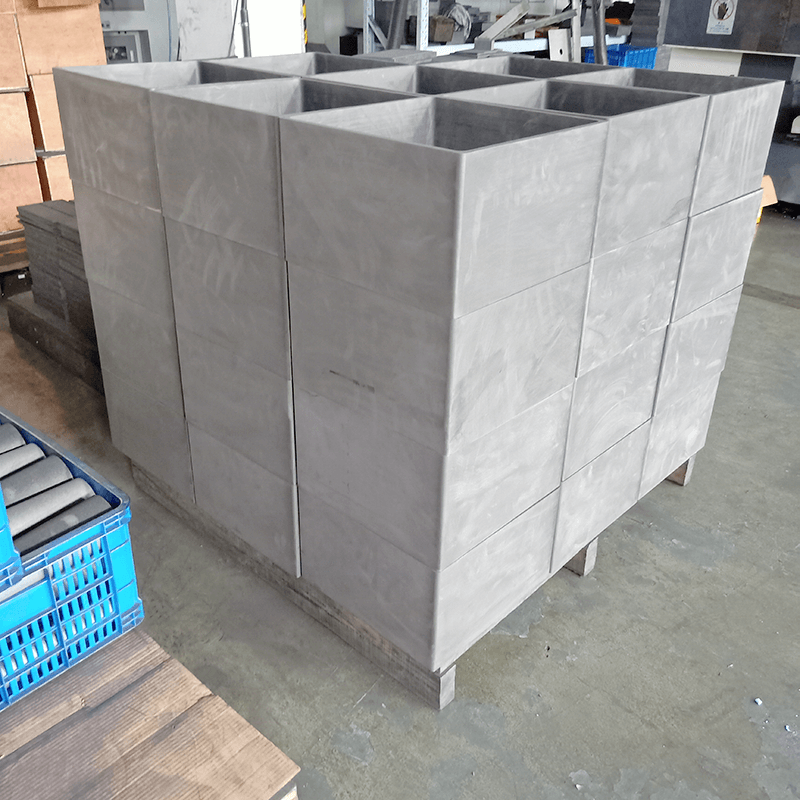
A reliable graphite sagger for anode materials must meet extreme purity thresholds. Ash content thresholds separate battery-grade containers from standard industrial ones. We define acceptable ash limits very strictly. High-end applications often demand less than 5ppm to 20ppm. Any ash residue represents potential battery contamination. You cannot compromise on these limits. Impurities cripple the specific capacity of the final anode product.
Trace metal risks threaten battery safety directly. We watch out specifically for Iron (Fe), Copper (Cu), and Zinc (Zn). These elements behave dangerously in battery chemistry. They disrupt the delicate SEI layer. They catalyze lithium plating inside the cell. They also promote dendritic growth during rapid charging cycles. Dendrites are sharp metallic structures. They pierce the delicate battery separators easily. This breach causes internal short circuits. It leads to catastrophic cell failures and dangerous thermal runaway. You must eliminate these elements at the sintering stage.
We must verify supplier purification processes meticulously. Look for high-temperature halogen purification methods. Suppliers inject halogen gases into vacuum furnaces at extreme temperatures. These gases react violently with trace metals. The reactions form volatile metal halides. The furnace then evacuates these halides completely. This process ensures the container meets strict battery-grade specifications. It extracts impurities trapped deep within the carbon matrix.
Trace Element Tolerance in Anode Sintering
Trace Element | Common Source | Impact on Battery Performance |
|---|---|---|
Iron (Fe) | Machining tools, raw coke | High self-discharge, micro-shorts |
Copper (Cu) | Furnace components, ambient dust | Voltage depression, lithium plating |
Zinc (Zn) | Airborne plant contaminants | Dendrite formation, capacity fade |
Engineers constantly balance wall thickness against internal capacity. Maximizing inner volume yields more powder per thermal cycle. However, reducing wall thickness compromises structural durability. Thin walls warp under high temperatures. They bow under the weight of dense silicon-carbon powders. We must find the optimal dimensional ratio. This ratio ensures both high throughput and physical stability. Many optimal designs hover between 10mm and 15mm for wall thickness.
Stacking and load distribution require careful design. Furnaces stack containers vertically to maximize production throughput. Facilities often stack columns ten to fifteen units high. Interlocking rims and stacking grooves are absolutely essential. They distribute heavy vertical loads evenly. Poorly designed rims create localized stress fractures. These fractures cause entire stacks to collapse mid-cycle. Such collapses destroy valuable product and damage delicate furnace heating elements.
Modern gigafactories demand robotic handling compatibility. Automated guided vehicles (AGVs) and robotic arms transport these containers constantly. They must feature specific corner radii. Reinforced bases are mandatory for safe lifting. The walls must withstand mechanical clamping forces from pneumatic grippers. Sharp edges chip easily under robotic gripping. Chipped edges generate dust and ruin the interlocking seal. You must align container geometry with AGV payload limits.
Internal geometry optimizes thermal gradients. Rounded inner corners prevent localized cold spots. Sharp inner corners trap powder and heat unevenly. Smooth transitions ensure uniform heat soaking. This guarantees uniform graphitization of the entire anode powder bed. Uniform powder performs consistently in finished battery cells. It eliminates batch variations and improves final cell grading.
Here are common best practices for geometric design:
Specify radiused corners to mitigate mechanical stress concentrations.
Incorporate reinforced bottom plates to prevent sagging under high-temperature loads.
Design interlocking steps allowing slight expansion gaps for thermal growth.
Match external dimensions strictly to your automated gripping tolerances.
Choosing the right battery anode sagger mitigates daily operational hazards. Oxidation rates determine the structural lifespan. Oxygen ingress occurs inevitably during furnace cooling cycles. Graphite reacts with oxygen violently at high temperatures. This chemical reaction causes steady, invisible weight loss. The container eventually loses its structural integrity completely. You must monitor this weight loss to predict failure accurately. Operators often track weight after every fifth cycle. Once weight drops by ten percent, the container becomes unsafe.
Coating technologies extend cycle life significantly. We evaluate protective surface treatments rigorously. Silicon carbide (SiC) coatings provide excellent barrier protection. Specialized anti-oxidation glazes also work well in semi-open atmospheres. These coatings seal the natural surface porosity. They block oxygen from attacking the internal carbon bonds. Effective coatings double the lifespan of standard containers. They apply via chemical vapor deposition to ensure uniform coverage.
Switching suppliers introduces serious implementation risks. You should never switch suppliers blindly. Conducting a limited-batch pilot run is critical. Different materials exhibit different thermal expansion coefficients. A new container might expand differently than existing furnace furniture. This mismatch causes furnace jamming. It can also cause catastrophic stacking collapses. Always manage supplier transitions carefully to avoid line stoppages.
Procurement requires strict data-backed validation. Do not rely solely on glossy supplier marketing sheets. We demand independent, third-party lab reports. ICP-OES analysis represents the gold standard in the industry. It stands for Inductively Coupled Plasma Optical Emission Spectroscopy. It verifies trace elemental composition accurately down to parts per billion. You need concrete analytical data before approving a new vendor. Require this documentation upfront. Do not accept vague certificates of analysis.
Batch consistency audits are equally vital. Producing one perfect prototype is relatively easy. Maintaining uniform density across thousands of units is exceptionally hard. You must question the supplier's volume manufacturing capacity. Audit their quality control checkpoints. Ensure they test density and purity on every single production lot. Ask for their statistical process control data. High standard deviation in density signals poor manufacturing discipline.
We recommend a strict pilot testing protocol. Order a small sample batch first. Run these samples through 10 to 20 standard thermal cycles. Monitor their performance under real factory conditions. This proves their actual worth before a massive rollout.
Follow these steps during pilot evaluation:
Weigh the containers before and after every cycle to track oxidation loss.
Measure external dimensions with digital calipers to detect thermal warping.
Inspect internal corners for micro-cracks using fluorescent penetrant testing.
Calculate the exact performance yield before committing to a full fleet replacement.
Selecting a sintering container is an engineering decision. It is never a simple commodity purchase. Material density directly dictates production yield. Verified chemical purity ensures ultimate battery safety. Robust geometry prevents automated handling disasters. These three pillars support your entire sintering operation. They determine whether your facility runs smoothly or constantly battles contamination.
We advise auditing your current replacement rates immediately. Identify premature failure modes in your existing stock. Then, contact specialized graphite manufacturers. Request an updated ash-content analysis for comparison. Finally, initiate a sample pilot program to validate performance. Rigorous testing always protects your production line. Proactive evaluation ensures maximum operational efficiency and safeguards your powder quality.
A: The ideal ash content should be extremely low. It typically sits under 20ppm for high-end battery applications. Ultra-premium grades often push this below 5ppm. This strict limit prevents trace impurities from migrating into the anode powder during high-temperature graphitization.
A: A high-quality container typically lasts between 30 and 60 cycles. This depends heavily on the furnace atmosphere and cooling protocols. Applying anti-oxidation coatings like Silicon Carbide (SiC) can push this lifespan even higher by protecting the substrate from oxygen attack.
A: Yes, internal geometry heavily influences thermal uniformity. Rounded corners and optimized wall thicknesses prevent cold spots. This ensures the entire powder bed reaches the required graphitization temperature simultaneously. It results in a consistent crystalline structure and maximized specific capacity.
A: Isostatic pressing creates a uniform, non-directional grain structure. This prevents the material from cracking under rapid heating and cooling. Extruded graphite has directional grains that act as weak points. This makes extruded material highly susceptible to thermal shock and premature failure.

 +86-795-4605783
  sales@nhdcarbon.com
  No. 966 of Tiangong South Avenue, High-tech Industrial Park, Fengxin County, Yichun City, Jiangxi Province, China.


