


Views: 0 Author: Site Editor Publish Time: 2026-08-22 Origin: Site


In lithium-ion battery manufacturing, the margin for error during graphitization and sintering is practically zero. Uneven heat distribution directly degrades battery capacity. It severely reduces overall cycle life. Plant operators face immense pressure to maintain strict thermal profiles across entire powder beds. While often viewed as a simple consumable, the graphite sagger for battery anode production acts as the primary thermal interface. It bridges the intense furnace heat and the sensitive active material. You rely on it to dictate how efficiently thermal energy transfers into the powder core.
Suboptimal crucibles lead to unpredictable yields. Optimizing sagger design becomes a decisive operational lever. You must carefully balance wall thickness, geometry, and material grade. This calculated balance maximizes temperature uniformity. It minimizes cross-contamination risks. Ultimately, it drives up your first-pass yield. We will explore how engineering geometry and advanced materials elevate production consistency. You will learn actionable strategies to select the right components for your specific furnace requirements.
Thermal Dynamics: Sagger geometry and wall thickness dictate heat transfer rates; suboptimal designs cause severe core-to-edge temperature gradients.
Yield Protection: Precision-machined sealing and stacking mechanisms prevent volatile gas intrusion and material oxidation.
Cost-per-Cycle: Evaluating saggers based on initial price ignores the total cost of ownership; high-density, low-porosity graphite extends lifecycle and prevents premature spalling.
Vendor Selection: Successful procurement requires assessing a manufacturer’s raw material consistency (e.g., isostatic graphite) and custom machining tolerances.
Graphitization demands extreme precision. Inconsistent thermal penetration creates severe mechanical problems inside the powder batch. Heat moves from the exterior walls toward the center. Poorly designed walls disrupt this flow. The outer edges of the powder bed bake too quickly. Meanwhile, the inner core remains significantly under-sintered. This variability destroys batch uniformity. It forces engineers to downgrade or completely discard the produced active material.
Inefficiency carries a massive penalty. Discarding non-compliant batches wastes expensive precursor materials. It disrupts gigafactory supply chains. Investing in precision-engineered anode sintering graphite components prevents this continuous waste. High-quality components stabilize the thermal environment. They protect the core powder from unexpected temperature drops. You must view these containers as critical production assets.
To succeed, operators must evaluate saggers against strict performance criteria. You should demand the following baseline metrics:
Thermal conductivity stability: The material must transfer heat uniformly over repeated cycles reaching up to 3000°C.
Structural integrity: The container must resist sudden thermal shock and high-temperature deformation.
Chemical inertness: The walls must not react chemically, preventing active material contamination.
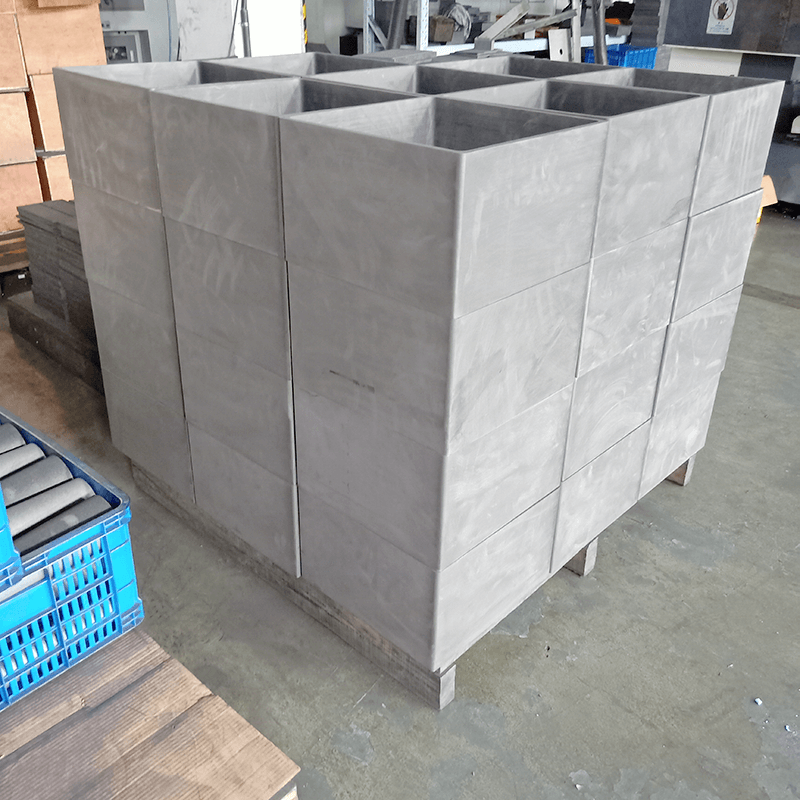
Wall thickness directly governs heat transfer rates. Operators constantly face a challenging trade-off. Thinner walls accelerate thermal saturation. They reduce overall energy consumption. However, thin walls compromise structural lifespan. They crack under repeated thermal stress. The optimal approach utilizes graduated thickness. Manufacturers can reinforce load-bearing zones. They keep side walls thinner for heat flow while strengthening the base and corners for durability.
Geometric profiling significantly alters powder behavior. Square shapes maximize furnace space. However, they introduce internal corner radii challenges. Sharp internal corners create dangerous "cold spots." Powder aggregates in these corners and fails to reach the required activation energy. Smooth, engineered radii eliminate these dead zones. Aspect ratios also matter. The height versus width dictates the thermal gradient of the packed powder bed. Tall, narrow containers heat differently than shallow, wide ones.
Table: Geometric Comparison of Sagger Shapes
Geometry Type | Furnace Space Utilization | Thermal Uniformity | Primary Risk Factor |
|---|---|---|---|
Square / Rectangular | Excellent (High density packing) | Moderate to High (Depends on radii) | Cold spots in sharp internal corners |
Cylindrical | Poor (Leaves gaps between units) | Excellent (Uniform radial heat) | Lower payload capacity per batch |
Custom Profiled | Very Good | Very High | Higher initial machining complexity |
Venting and gas evacuation mechanisms round out the core design variables. Active materials release binder gases during early heating phases. Saggers must vent these volatile gases efficiently. However, the design cannot let furnace impurities penetrate the interior. Specialized lid designs allow outward off-gassing while blocking inward impurity flow.
Best Practice: Always align your aspect ratio choice to your specific furnace type. Roller hearth furnaces benefit from shallower beds. Acheson furnaces often require taller, heavily reinforced structures.
Material purity serves as the foundation of battery quality. Specifying ultra-low ash graphite is strictly non-negotiable. Ash content must remain below 50 ppm. Metallic impurities like iron or copper poison the anode powder. They cause internal short circuits inside the finished battery cells. High purity prevents this chemical poisoning entirely.
Porosity dictates oxidation resistance and structural longevity. High-density graphite acts as a physical shield. It prevents fine powder infiltration into the walls. When graphite is too porous, microscopic powder particles seep deep into the material. As the furnace cools, these trapped particles expand differently than the graphite. This mismatch causes severe micro-cracking. Over time, the surface spalls off. Spalling ruins the batch and destroys the container.
Stacking and sealing architecture directly prevents external contamination. Production environments utilize intense continuous vibration. Interlocking lip designs maintain stability. Tongue-and-groove configurations lock the stacked units together. Precision machining prevents crucible shifting during transit. This tight seal maintains an isolated micro-environment for the powder. It stops volatile elements from cross-contaminating adjacent batches.
Common Mistake: Relying on flat-lip covers. Flat designs vibrate out of alignment during automated handling, breaking the seal and exposing the powder to severe oxidation.
Raw material selection defines long-term performance. Procurement teams often compare molded, extruded, and isostatic graphite. We highly recommend isostatic pressing. Isostatic processes apply equal pressure from all directions during manufacturing. This creates truly isotropic thermal properties. The material expands uniformly under extreme heat. It delivers maximum lifespan in high-stress environments. Choosing a specialized graphite sagger for anode materials made from isostatic blocks minimizes catastrophic structural failures.
Machining tolerances heavily influence operational flow. Dimensional accuracy matters immensely in modern gigafactories. Automated filling machines handle these containers rapidly. Robotic arms stack and empty them continuously. Poor dimensional tolerances jam automated equipment. A jammed line halts production and breaks expensive machinery. You must demand tight dimensional controls from your supplier.
Shift your evaluation from isolated unit pricing toward cycle-based performance metrics. Calculate your return on investment based on increased powder payload capacity. Measure this against expected replacement frequency. A denser, structurally superior unit holds more powder per batch. It survives far more sintering cycles. You optimize efficiency by maximizing the operational longevity rather than merely seeking the cheapest initial purchase.
Integrating new designs requires structured pilot testing protocols. Never roll out untested geometries across your entire production line. Establish strong baseline metrics first. Test the new designs across 20 to 30 full thermal cycles. Monitor the temperature gradients meticulously. Analyze the resulting anode powder for strict uniformity. Only proceed to full integration after validating these controlled samples.
Handling and maintenance dictate daily survival. Automated transit systems pose severe risks of mechanical impact. Conveyor transitions jolt the containers. Robots occasionally apply uneven gripping pressure. Your components must possess sufficient mechanical strength to endure this physical abuse. Additionally, operators must enforce strict cooling protocols. Rapid cooling exceeds the material's Coefficient of Thermal Expansion (CTE) limits. Exceeding CTE limits shatters even the highest-grade isostatic graphite instantly.
Apply rigorous shortlisting logic when selecting a manufacturing partner. Verify their engineering capabilities thoroughly. Ask if they offer custom thermal modeling using Finite Element Analysis (FEA). They should tailor this modeling to your specific furnace type. Acheson furnaces act differently than continuous roller hearths. Finally, request sample runs. Demand batch-tracked quality assurance data to verify their consistency.
Sagger geometry and material properties act as active variables dictating sintering efficiency, not static specifications.
Prioritizing ultra-low ash content and high material density strictly prevents contamination and micro-cracking.
Precision tongue-and-groove sealing protects internal micro-environments from volatile furnace gases.
Evaluating components based on cycle longevity and structural endurance yields significantly higher production efficiency.
Transforming your operations requires proactive engagement. We strongly recommend auditing your current lifecycle metrics immediately. Consult an engineering specialist to analyze your unique thermal profile. Request a bespoke prototype. By doing so, you turn a simple consumable into a powerful, yield-generating asset.
A: The ideal thickness depends entirely on your furnace type and payload. Thinner walls improve thermal transfer, while thicker walls boost structural rigidity. Manufacturers typically engineer a bespoke graduated thickness. This calculation balances rapid heat saturation against the mechanical strength needed to survive repeated handling.
A: Isostatic graphite undergoes omnidirectional pressing during manufacturing. This creates isotropic properties, meaning it features uniform multi-directional strength and thermal conductivity. It expands evenly under extreme heat. This drastically reduces the risk of uneven expansion and thermal cracking compared to standard molded variants.
A: Cycle lifespan varies heavily based on peak operating temperatures and cooling speeds. However, high-quality components offer predictable, documented degradation curves. These predictable curves allow operators to schedule preventative replacements safely, ensuring continuous production without risking sudden structural failure or batch loss.
A: Yes. Optimized geometry and density ensure uniform heat distribution. This guarantees the entire powder bed reaches the exact activation energy required for consistent graphitization. Eliminating internal cold spots directly prevents varying capacity retention issues in the final assembled battery cell.

 +86-795-4605783
  sales@nhdcarbon.com
  No. 966 of Tiangong South Avenue, High-tech Industrial Park, Fengxin County, Yichun City, Jiangxi Province, China.


